




Historic Heart of the Holy City
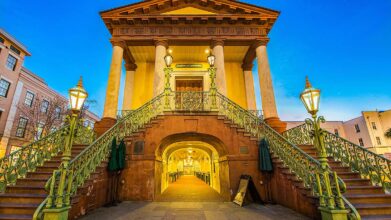
Cobblestone alleys, flickering gaslit lanterns, and historic churches define Charleston’s French Quarter District. Situated in the culturally rich core of the original 17th-century walled city, this neighborhood contains centuries of preserved architecture, art galleries, and harbor breezes. Travelers discover romantic ambiance along shaded footpaths, historic playhouses, and waterfront vistas.
Exploring this legendary sector reveals the storied past of early settlers, Revolutionary War events, and architectural preservation. Every block within Charleston’s French Quarter District features landmark structures, inviting plazas, and local lore. This guide serves as a helpful resource for discovering the top things to do across one of the most celebrated Charleston historic districts.

At Old Town Trolley Tours, We Make Vacations Better® for visitors exploring South Carolina’s Lowcountry. Our conductors share captivating history and local insights as we guide you through historic streets.
From French Huguenot Refuge to Walled Port
Understanding Charleston’s French Quarter District begins with the arrival of French Huguenot Protestants in the 1680s. Fleeing religious persecution in Europe, these skilled artisans, merchants, and landowners established homes and businesses in this section of town, giving the neighborhood its name.
The Fortified Settlement
The neighborhood developed inside the original fortified walls of early Charles Town. Bounded by military defense trenches and the Cooper River, the sector functioned as a protected shipping hub. Docks, counting houses, and warehouses lined the waterfront, receiving goods from transatlantic trade ships.
Preservation Milestones
Over centuries, visionary preservation efforts protected the architectural integrity of the sector. Dedicated organizations saved 18th-century warehouses, historic churches, and original residential structures. Today, Charleston’s French Quarter District stands as a central jewel among Charleston’s historic districts, recognized globally for its high concentration of preserved historic buildings.
Secret Alleys, Stage Firsts, and Pirate Lore
Hidden pedestrian paths and historical landmarks give the French Quarter in Charleston its unique charm.

Philadelphia Alley
Originally called Cow Alley, Philadelphia Alley offers a quiet walk beneath a lush canopy of trees. The secluded passage gained a reputation during the 18th century as a private location for gentlemanly duels. Today, the brick path provides a peaceful retreat right in the middle of the city.

Dock Street Theatre
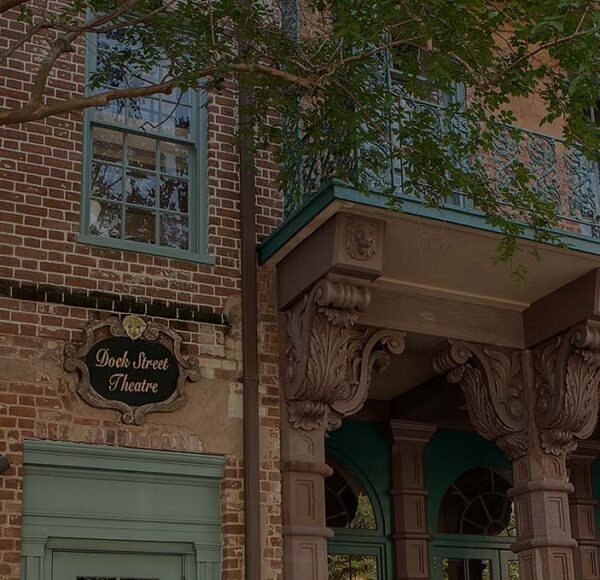
Opening in 1736, the Dock Street Theatre holds honor as the first building in America constructed exclusively for theatrical performances. The original venue presented early opera performances and plays before suffering fire damage. Rebuilt as the Planters Hotel in 1809, the structure underwent extensive restoration in the 1930s to reopen as a historic playhouse.

The Pink House
Located at 17 Chalmers Street, the Pink House was constructed around 1712 out of reddish Bermuda pink stone. Featuring thick walls and a gambrel roof, this small historic structure functioned as a colonial tavern and residence. It remains one of the oldest surviving masonry buildings in South Carolina.
Essential Visitor Tips: Know Before You Go
Planning your outing around seasonal events and neighborhood logistics ensures an enjoyable journey through Charleston’s French Quarter District.
1
Attend Seasonal Art Walks: Local art galleries host Friday evening French Quarter Art Walks throughout the year. Galleries welcome visitors with live music, wine, and featured artwork.
2
Select Sturdy Footwear: Navigating historic cobblestone streets like Chalmers Street and uneven brick pavements requires supportive walking shoes.
3
Time Your Waterfront Visits: Pairing an afternoon of gallery viewing with a late afternoon walk to Waterfront Park allows you to enjoy cool harbor breezes and sunset views.
4
Plan for Evening Dining: Independent bistros, seafood houses, and taverns line the district streets. Securing dinner reservations in advance guarantees a table during peak travel seasons.
District Landmarks and Attractions
Exploring Charleston’s French Quarter District brings you face-to-face with magnificent sacred architecture, historic playhouses, and waterfront parks.
St. Philip’s Episcopal Church
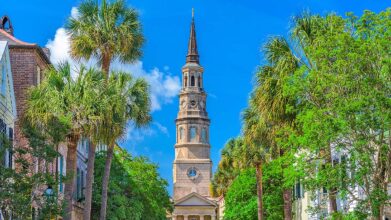
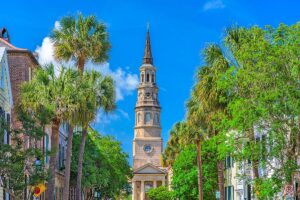 Located at 142 Church Street, St. Philip’s Episcopal Church is an iconic National Historic Landmark. The current Anglo-Classical Revival sanctuary was constructed in 1836, featuring a soaring steeple that historically served as a navigational beacon for ships entering the harbor. The adjacent historic cemeteries hold the graves of prominent historical figures, including South Carolina statesmen, signers of the Declaration of Independence, and regional leaders.
French Huguenot Church
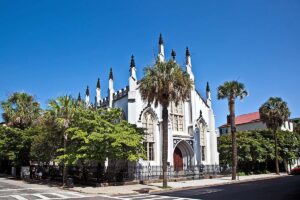 Situated at 136 Church Street, the French Huguenot Church stands as a striking example of Gothic Revival architecture. Completed in 1845, the pink stucco structure features stuccoed pinnacles, lancet windows, and delicate ironwork. It remains the only active independent Huguenot congregation in the Western Hemisphere, preserving the heritage of the early French settlers who established the neighborhood.
Dock Street Theatre
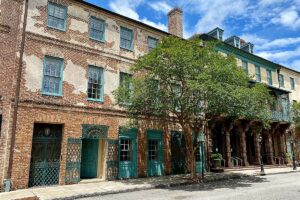 Located at 135 Church Street, the historic Dock Street Theatre continues its legacy as a cultural center. The venue hosts live theatrical plays, musicals, and classical performances produced by the Charleston Stage Company. Visitors can tour the interior to admire the cypress woodwork, ornate balconies, and historic courtyard.
Waterfront Park and Pineapple Fountain
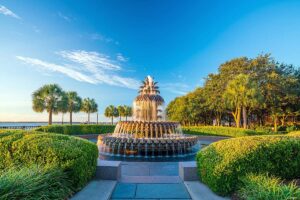 Bordering the eastern edge of the French Quarter in Charleston along the Cooper River, Waterfront Park covers 8 acres of green space. Paved walking paths, shaded pier swings, and manicured lawns provide views of harbor boat traffic. The central feature of the park is the bronze Pineapple Fountain, an iconic symbol of Lowcountry hospitality.
Exploring Beyond the Quarter: Nearby Points of Interest
A wide array of attractions sits steps away from the boundary lines of Charleston’s French Quarter District.
Charleston City Market
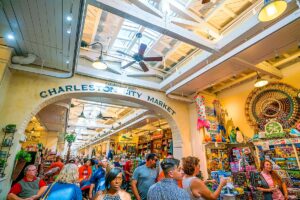 Forming the northern border of the French Quarter in Charleston, the Charleston City Market spans four historic blocks. Established in the late 18th century, the open-air market sheds host local craft artisans, food vendors, and Gullah sweetgrass basket weavers.
Rainbow Row
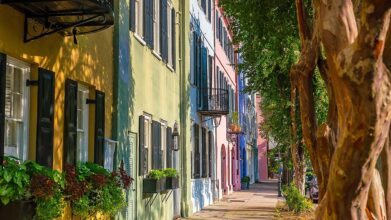
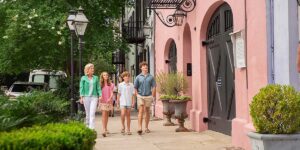 Located along East Bay Street, Rainbow Row features 13 pastel-colored historic row houses built during the 18th century. Restored during the 1930s, these colorful facades create one of the most photographed streetscapes in the nation.
Old Exchange and Provost Dungeon
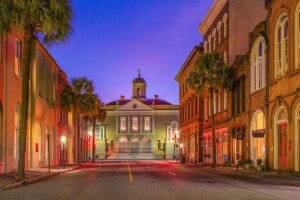 Situated at East Bay and Broad Streets, the Old Exchange and Provost Dungeon was completed in 1771. The colonial structure served as a customs house, post office, and city hall. British forces used the underground vaults as a military prison during the Revolutionary War.
South of Broad Neighborhood
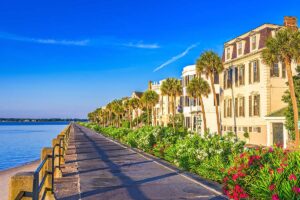 Extending south across Broad Street, the South of Broad district presents grand antebellum estates, tree-lined avenues, and harborfront views along The Battery.
Nathaniel Russell House
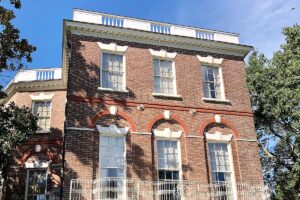 Located at 51 Meeting Street, this neoclassical house museum was completed in 1808. The home is famous for its interior three-story free-flying spiral staircase and restored period rooms.

The Best Way To Tour the French Quarter
Exploring the historic lanes of Charleston’s French Quarter District is essential for history lovers, theatergoers, and art enthusiasts. Driving through this historic sector presents challenges, as narrow one-way streets, heavy pedestrian traffic, and limited parking garages make driving difficult.
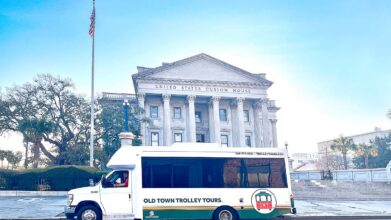
Choosing Old Town Trolley Tours provides a comfortable sightseeing solution. Our continuous, fully narrated tour route carries you through the city without the hassle of driving or managing vehicle parking. Our knowledgeable conductors deliver engaging Transportainment®, bringing centuries of Lowcountry history to life with captivating stories and local insights. Choosing Old Town Trolley Tours ensures your journey through Charleston’s historic district is informative, relaxing, and memorable.
FAQs
Charleston’s French Quarter District is bounded by Market Street to the north, Broad Street to the south, Meeting Street to the west, and the Cooper River to the east.
The sector earned its name from the high concentration of French Huguenot immigrants who settled in this part of the city during the late 17th century after fleeing religious persecution in Europe.
The Pink House, located at 17 Chalmers Street, was built around 1712 out of Bermuda pink stone, standing as one of the oldest surviving structures in the city.
Yes, Old Town Trolley Tours features stops situated at major locations adjacent to the French Quarter in Charleston, including the Charleston City Market and waterfront areas.
Yes, historic sanctuaries like St. Philip’s Episcopal Church and the French Huguenot Church welcome visitors during designated weeknight visiting hours and weekly religious services.
Charleston’s French Quarter District stands out for its concentration of historic theaters, art galleries, French Huguenot heritage, and original 17th-century walled city footprint.
The continuous, fully narrated tour route takes guests on a complete circuit through the historic peninsula, offering a comprehensive overview of top sights.
Exploring Charleston’s French Quarter District on foot allows travelers to wander through historic hidden alleys like Philadelphia Alley, inspect colonial architecture up close, and enjoy art galleries along Church Street. The compact neighborhood grid places historic churches, the Dock Street Theatre, and Waterfront Park within easy walking distance.
Near the eastern waterfront edge of the French Quarter in Charleston, travelers can visit Waterfront Park to see the bronze Pineapple Fountain and enjoy views of harbor boat traffic. Just steps away along East Bay Street sit the iconic pastel-colored row homes of Rainbow Row and the colonial Old Exchange and Provost Dungeon.