



Lightner Museum: History is Just Around The Corner
The Building
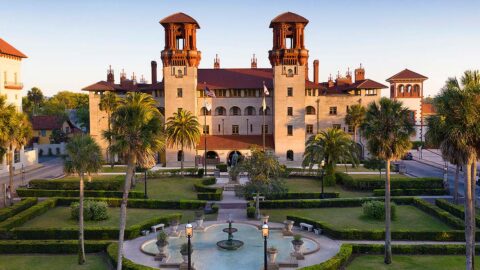
Designed by architects Carrère and Hastings, the Hotel Alcazar was the second resort hotel built by Gilded Age industrialist Henry Flagler in St. Augustine. Originally envisioned as a recreational annex to the Hotel Ponce de Leon, the project quickly evolved into a destination of its own. The Alcazar welcomed its first guests on Christmas Day, 1888.
The Alcazar was designed around three interconnected components: the hotel guest rooms, the baths, and the casino. At the north end of the complex, the guest rooms surrounded a lush interior courtyard filled with tropical plants and framed by a covered arcade of luxury shops. What set the Alcazar apart from the larger Ponce de Leon Hotel was its extensive indoor recreation and entertainment facilities, which attracted both hotel guests and local residents. The center of the complex housed the baths, a series of spaces dedicated to health and wellness. To the south stood the casino, a dramatic four-story entertainment hall featuring a large indoor swimming pool, a grand ballroom, and a bowling alley. Beyond the casino, croquet lawns and tennis courts completed the resort experience.
As the twentieth century progressed, changing travel habits and expanding vacation options led to a gradual decline in visitors to Flagler’s St. Augustine hotels. Following the Wall Street Crash of 1929 and the onset of the Great Depression, the Alcazar closed as a hotel in 1931.
The Museum
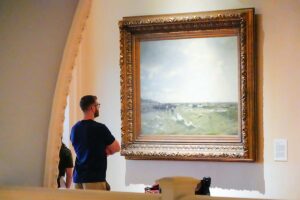 Born in Norwich, Kansas, in 1886, Otto Lightner became one of America’s leading advocates for hobbies and collecting through his publication, Hobbies — The Magazine for Collectors. As the eight-hour workday and five-day workweek became more common, civic leaders and social reformers encouraged Americans to use their growing leisure time in meaningful ways. The hobby movement emerged from the belief that collecting, crafting, and other creative pursuits offered both enjoyment and personal enrichment.
In 1934, Lightner opened a unique museum in Chicago dedicated to hobbies and collecting. Alongside artwork, antiques, and furnishings acquired from some of Chicago’s great Gilded Age mansions, the museum also showcased collections donated by hobbyists from across the country. Lightner believed that everyday collections could be just as fascinating and worthy of display as traditional museum treasures.
After visiting St. Augustine and staying at the Hotel Ponce de Leon in 1946, Lightner purchased the former Hotel Alcazar as the permanent home for his growing collection. The Lightner Museum of Hobbies opened to the public in 1948, continuing its founder’s mission to celebrate collecting, creativity, and the passions of ordinary people.
The Collection
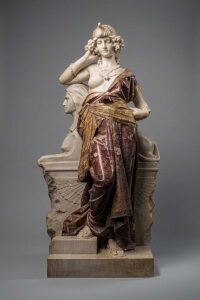 At the heart of the Lightner Museum are its remarkable and eclectic collections. From Gilded Age furniture and vintage typewriters to American art glass and Victorian mechanical musical instruments, the museum offers visitors an extraordinary glimpse into the art, culture, and daily life of the nineteenth and early twentieth centuries.
Otto Lightner often described his museum as a “collection of collections.” A leading figure in the American hobby movement, he believed that collecting enriched people’s lives and connected them to history, craftsmanship, and one another. In the first issue of Hobbies magazine, he wrote: “Have you a hobby? Certainly if you have not, you should have one. Hours of keen enjoyment await you as a collector.”
While Lightner championed hobbies of every kind — from stamp collecting and cigar-label albums to wood carving and needlework — he also assembled an extensive personal collection. His interests ranged across fine and decorative arts, natural history specimens, scientific curiosities, and Americana from the nineteenth and early twentieth centuries.
When he established the first Museum of Hobbies in Chicago in 1934, Lightner invited readers of Hobbies magazine to share their collections with the public. The museum quickly became a celebration of both individual passions and shared cultural heritage. In 1946, during a stay at the Hotel Ponce de Leon, Lightner purchased the neighboring Hotel Alcazar to provide a permanent home for his expanding museum.
Today, the Lightner Museum’s collections are displayed throughout the former Gilded Age hotel. The historic architecture serves as a dramatic backdrop for exhibitions that combine fine art, decorative arts, and whimsical curiosities. Together, the collections and the building create an immersive museum experience that continues to inspire curiosity, discovery, and delight for visitors of all ages.
The Museum’s Digital Guide
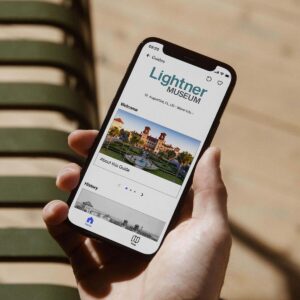 Enhance your visit with the Lightner Museum’s free digital guide on Bloomberg Connects. Enjoy audio tours, learn more about what’s on view, discover collection and exhibition highlights, and access exclusive content — all from your mobile device. Explore the museum at your own pace, then revisit your favorite works anytime, anywhere.
Explore a variety of guided content designed to enhance your visit:
- Interactive Maps – Navigate the building and easily locate exhibitions and featured artworks.
- Translations – access the guide in more than 60 languages.
- Audio Tours – Explore the museum through themed audio tours highlighting our historic building and the unique collection housed within.
- Current Exhibitions – Discover what’s currently on view, with highlights from the museum’s collection and special exhibitions.
- Plan Your Visit – Find helpful information and simple instructions to make the most of your visit to the Lightner Museum.
- Access the Guide