

Washington DC
SELECT CHANGE




Smithsonian National Air and Space Museum
One can only imagine the exhilaration that Neil Armstrong felt as he took the very first steps on the moon in 1969 or the incredible thrill that the Wright brothers experienced as they took that first flight in 1903. At the Smithsonian Air and Space Museum, you can get an idea of how they felt when you see first-hand the original Wright 1903 Flyer and the Apollo 11 Command Module, which carried astronauts Neil Armstrong, Michael Collins, and Buzz Aldrin on their mission to the moon. These historic aircraft and spacecraft are part of the museum’s collection of more than 30,000 artifacts.
-
 Shopping
 -
 Dining
 -
 Entertainment
 -
 Restrooms
Visiting the Smithsonian National Air and Space Museum with Old Town Trolley Tours
The smartest, most time-efficient way to tour the world-famous Smithsonian National Air and Space Museum and the surrounding institutions is with Old Town Trolley Tours. This hop-on/hop-off service eliminates parking frustrations and provides direct, convenient access to the museum’s entrance on the National Mall. Old Town Trolley Tours is the essential, expertly-guided link between the most popular exhibits and the rest of Washington D.C.’s landmarks.
Why Choose Old Town Trolley Tours?
- Dedicated Museum Stop: The trolley features a designated stop directly near the museum entrance, providing the shortest walk possible from the curb to the museum’s entrance, so you can immediately begin exploring.
- Zero-Stress Transit: Bypass D.C.’s heavy traffic and high parking costs; your expert conductor navigates directly to the National Mall.
- Optimized Day Planning: Use the continuous hop-on/hop-off service to transfer efficiently between the museum and other DC attractions.
- Educational Context Delivered: Enjoy live narration from the certified conductors who provide rich historical context about the museum’s location, the stories of flight, and space exploration, making the journey part of the overall educational experience.
Air and Space Museum Visitor Information
- Admission is Free: As part of the Smithsonian Institution, entry to the museum is free, though timed-entry passes are required for the Washington, D.C. location.
- Iconic Artifacts: You can see some of the most important objects in flight history, including the 1903 Wright Flyer, the Apollo 11 Command Module Columbia, and the Spirit of St. Louis.
- Explore History and Technology: The museum houses the world’s largest and most significant collection of aviation and space artifacts, educating and inspiring visitors about the history, science, and technology of flight.
- Touch a Moon Rock: A unique, hands-on opportunity allows visitors to touch a sample of lunar rock brought back from the Apollo 17 mission.
- Convenient to Other Attractions: Located on the National Mall, the museum’s central location is often a stop on trolley tours, making it easy to access other major points of interest in Washington, D.C.
Loading video...
Ultimate Guide To The Smithsonian National Air and Space Museum
Twenty-three different galleries feature amazing items related to the history of aviation and space flight throughout the world. ‘Milestones of Flight’, ‘Pioneers of Flight’, ‘Aviation in WWII’, and ‘Space Race’ are some of the exhibits that fascinate visitors to the museum. Featuring planes, space modules, flight simulators, interactive exhibits, the Albert Einstein Planetarium, and an IMAX theater, the Smithsonian Air and Space Museum offers education and entertainment for guests of all ages. Visitors can also take guided tours, and the museum includes a food court and a three-level shop.
The masterful drawings of Leonardo da Vinci and mythological stories like the cautionary tale of Icarus flying too close to the sun reveal humanity’s enduring fascination with flight and space travel. The Smithsonian National Air and Space Museum chronicles the efforts of famous engineers, scientists, aviators, and astronauts. Learn how these pioneers pushed the limits and slipped the surly bonds of earth on their quests to venture where no one had gone before.
 History of the Museum
 History of the Museum
The museum is situated on the former site of the District’s armory, which served as a hospital during the Civil War. Originally the National Air Museum, the institution was established by an act of Congress in 1946. With the space race in the 1950s, the museum was renamed the National Air and Space Museum. A portion of the collection was initially displayed in a variety of locations, including the Art and Industries Building and a tent erected behind the Smithsonian Castle. The majority of the collection remained in storage until completion of the current pink Tennessee marble building in 1976.
The design consists of marble cubes linked by three spacious atria made of glass and steel. While the cubes accommodate smaller pieces and theatrical exhibits, the larger gallery space of the atria is used to display rockets, airplanes, and spacecraft.
Must-See Attractions
Some of the pieces in the Smithsonian Air and Space Museum’s collection, like the Chinese Imperial kites, date from the 1876 Centennial Exposition held in Philadelphia. The Stringfellow steam engine, designed to power aircraft, was added 23 years later. There is also a genuine moon rock. The museum is organized into several galleries dedicated to major aspects of flight.
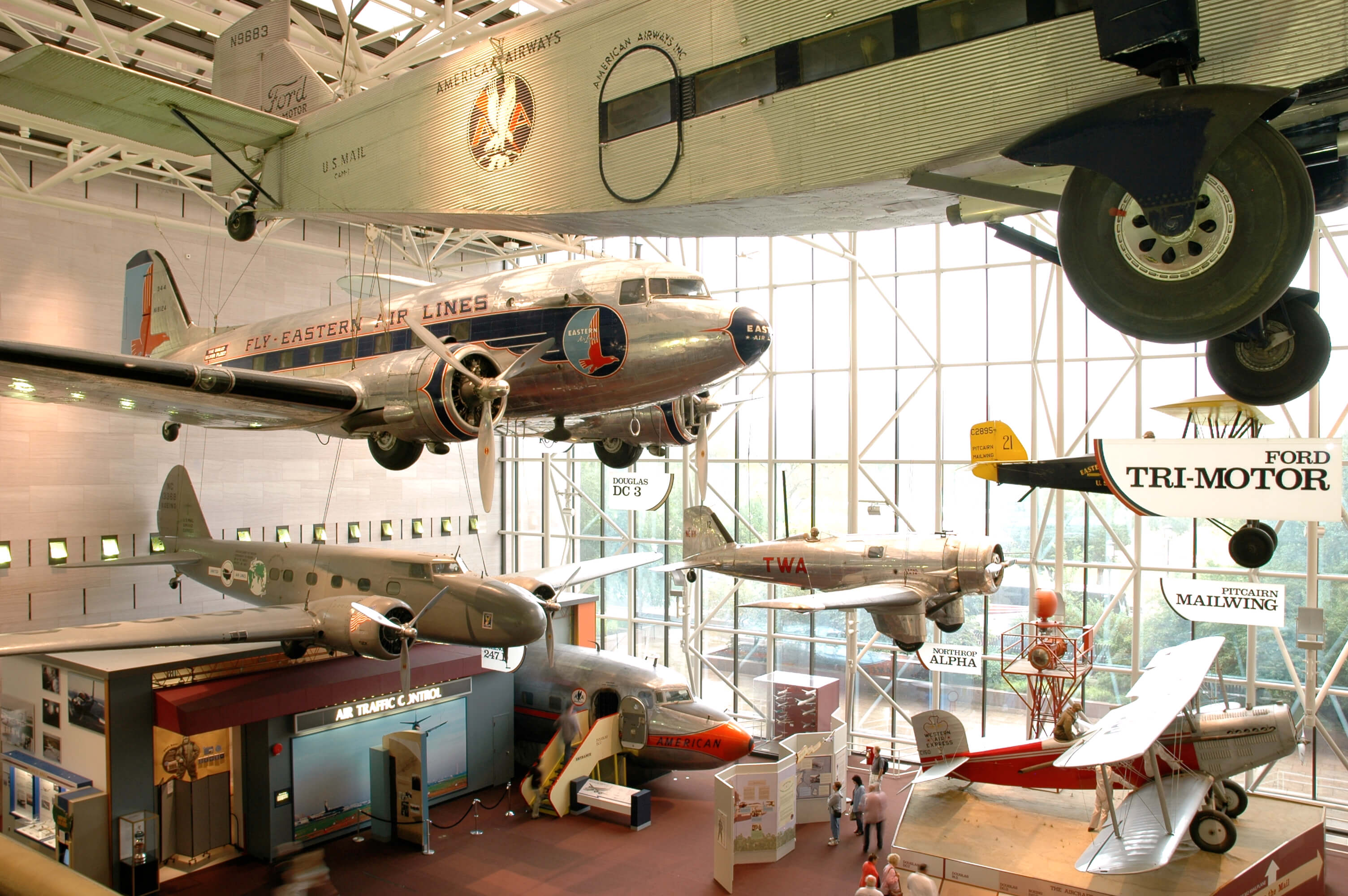 The entrance hall to the Air and Space Museum contains the Milestones of Flight, celebrating some of the most significant aircraft in history. They include historic aircraft such as Charles Lindbergh’s Spirit of St. Louis and the Bell X-1, and spacecraft like John Glenn’s Friendship 7 space capsule and the Mariner, Pioneer, and Viking space probes. Legendary test pilot Chuck Yeager was at the controls of the X-1 when he broke the sound barrier for the first time in history. In other exhibits, you can gain deeper insights about the space race and aircraft carrier deck landings.
With the Kitty Hawk Flyer as its centerpiece, the Wright Brothers and the Invention of the Aerial Age Gallery tells the story of the first powered flight. It also relays how aviation had a monumental impact on the world in the following decades. The Pioneers of Flight Gallery pays tribute to other men and women who overcame physical, psychological, and societal barriers at the birth of aviation. In addition to a plane flown by Amelia Earhart, there is an exhibit commemorating the legacy of African-Americans in aviation.
Several exhibits at the National Air and Space Museum are dedicated to military aircraft, aerial combat and unmanned aerial vehicles. Other exhibits teach visitors about jet aircraft, air travel, and the golden age of general aviation. Children will enjoy the hands-on How Things Fly Gallery that features interactive exhibits explaining the principles of flight and space travel.
In addition to a gallery dedicated to the use of aircraft and space observations to better understand our home planet, the Smithsonian National Air and Space Museum also houses exhibits chronicling the history and achievements in space exploration. A gallery features various spacecraft used in the initial exploration of the moon. Featuring a replica of the Voyager, the Exploring the Planets exhibit takes you through the universe to visit other planets. Learn how astronomical tools have advanced and revolutionized our understanding of the universe. The Apollo to the Moon Gallery chronicles the events that led to Neil Armstrong’s historic giant leap for mankind.
The National Air and Space Museum also houses a planetarium and IMAX theater. The Einstein Planetarium offers a number of complimentary star shows, including the night sky and trips through the universe. Purchase tickets to view movies in the Lockheed Martin IMAX Theater that showcasPurchase tickets to view movies in the Lockheed Martin IMAX Theater that showcase the Earth in 3D, the history of flight, and how engineers transform the world.
The Steven F. Udvar-Hazy Center is located at Dulles International Airport. It houses a variety of aircraft, including the B-29 Superfortress Enola Gay, an SR-71 Blackbird, and the Space Shuttle Discovery.
Know Before You Go
The Smithsonian National Air and Space Museum is open free of charge from 10 a.m. until 5:30 p.m. every day except Christmas. There are extended hours on select days during spring and summer. Visit the National Air and Space Museum website for more details. Lines to enter the museum are longest on weekends, holidays, and during the peak season from March to August. Dress comfortably and carry a limited number of bags. All visitors are required to pass through a metal detector. You are free to take pictures and connect to the museum’s complimentary Wi-Fi system. While only bottled water is permitted in the galleries, the museum has a food court offering a variety of fast food, snacks, and beverages.
Nearby Attractions
 Nearby Attractions
If time permits, visit one of these other popular attractions within walking distance of the National Air and Space Museum.
The third-most visited museum in the world, the National Museum of Natural History is a multi-story structure housing a more than 124 million piece collection. In addition to the Hope Diamond, items on display include fossils and human cultural artifacts that chronicle the natural history of the planet.
The faux Norman-style Smithsonian Castle was built in 1849 to initially house the institution’s ever-growing collection of artifacts. The distinctive red Seneca sandstone edifice houses the crypt of benefactor James Smithson as well as galleries featuring a sampling of artifacts displayed by the Smithsonian’s numerous individual museums.
 The U.S. Botanical Garden displays almost 10,000 living plant specimens, some of which are more than 165 years old. It features plants indigenous to the United States as well as tropical, exotic, rare and endangered specimens from around the world. Exhibits reflect desert, jungle and woodland biospheres.
FAQs
What are some must-see exhibits at the Air and Space Museum?
At the Air and Space Museum, visitors can marvel at a vast collection of historic aircraft and spacecraft, from the Wright brothers’ early flyers to the awe-inspiring Space Shuttle. Engage with interactive exhibits, witness the evolution of flight technology, and explore outer space through immersive planetarium shows. It’s a place where history, science, and technology converge to inspire dreams of future explorations.
How long does it take to visit the Air and Space Museum DC?
Expect to spend 2-3 hours exploring the Air and Space Museum’s exhibits, including spacecraft, aircraft, and interactive experiences.
Is the Air and Space Museum kid-friendly?
Absolutely! The Air and Space Museum is a paradise for curious kids, featuring interactive exhibits like flight simulators, life-size spacecraft replicas, and the chance to see real lunar rocks. It’s designed to inspire young minds about the wonders of flight and space exploration.